
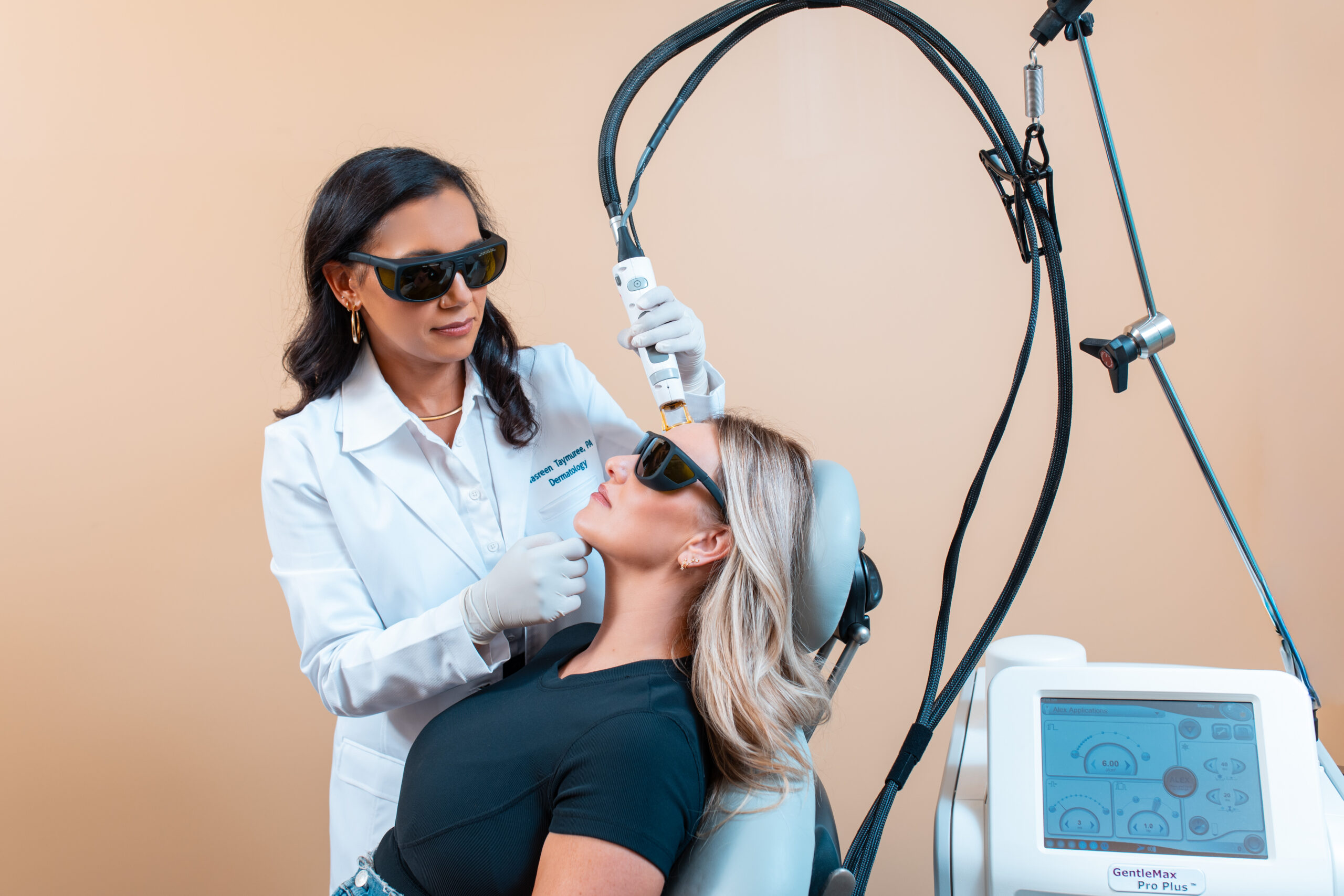
One of the biggest advantages of receiving laser treatment at Dermatology Associates of the Bay Area is access to a broad range of laser technologies under one roof. Many practices rely on a single resurfacing laser or a single vascular laser and attempt to treat every concern with that device. Our providers have access to multiple specialized laser platforms, allowing us to select the treatment that best fits your skin type, condition, goals, and desired recovery time.
Our laser technology includes:
- Fraxel Dual 1550 and 1927 for sun damage, pigmentation, and skin texture improvement
- Fraxel Clear + Brilliant for preventative skin rejuvenation and early signs of aging
- Lumenis AcuPulse CO2 laser for deeper wrinkles, advanced sun damage, and improvement of acne or surgical scars
- Cutera Excel V and Laser Genesis for rosacea, facial redness, visible blood vessels, angiomas, and overall skin rejuvenation
- Candela GentleMax Pro Plus for laser hair removal and select vascular and pigmented lesions
- Lumenis Quantum IPL for sunspots, brown spots, redness, and photorejuvenation
- MedLite C6 for tattoo removal and pigment correction
- XTRAC Excimer laser for psoriasis, vitiligo, eczema, and other localized inflammatory skin conditions
Because different skin concerns often require different wavelengths and treatment depths, having multiple technologies available allows us to create truly customized treatment plans rather than offering a one-size-fits-all approach.
Laser Treatments for Sun Damage and Pigmentation
Not all sun damage looks the same, and not all pigmentation responds to the same laser.
Patients often come in concerned about brown spots, blotchy skin tone, rough texture, or a complexion that appears older than they feel. During your consultation, we evaluate whether pigmentation is superficial, deeper within the skin, associated with redness, or accompanied by textural damage.
For diffuse sun damage and discoloration, IPL photofacial treatments using our Lumenis Quantum platform often deliver excellent results with minimal downtime. Patients typically experience temporary darkening of brown spots for several days before they gradually flake away.
For more significant sun damage, pigmentation, and textural changes, Fraxel Dual treatments may be recommended. The 1927 wavelength is particularly effective for pigment correction, while the 1550 wavelength penetrates deeper to stimulate collagen remodeling and improve skin quality.
For patients with advanced photodamage, deeper wrinkles, or unwanted scars, AcuPulse CO2 resurfacing may provide the most meaningful improvement.
Most patients notice brighter skin and more even tone after treatment, but realistic expectations are important. Significant sun damage often develops over decades and may require a series of treatments combined with ongoing sun protection and skincare to achieve optimal results.
Laser Treatments for Scars and Skin Texture
Surgical or acne scars are among the most rewarding—and often most misunderstood—conditions we treat with laser technology.
Many patients expect scars to disappear completely. While CO2 laser resurfacing can produce substantial improvement, the goal is typically scar softening, smoother texture, and reduced visibility rather than complete scar elimination.
Fraxel 1550 is one of our most commonly used treatments for acne scarring because it stimulates collagen remodeling beneath the skin while preserving surrounding tissue. Improvements continue to develop for several months following treatment as new collagen forms.
For deeper acne or surgical scars, deeper resurfacing with AcuPulse CO2 laser may be recommended. Some patients benefit from combining laser treatments with other scar-revision techniques to maximize results.
Laser Treatments for Rosacea, Facial Redness and Broken Blood Vessels
Redness can be one of the most frustrating skin concerns because topical products often provide limited improvement once visible blood vessels have formed.
Our Cutera Excel V laser targets superficial blood vessels responsible for persistent redness, flushing, and vascular rosacea. By selectively heating these vessels, the laser allows the body to gradually clear them over time. Common vascular lesions that we treat include telangiectasia and cherry angiomas.
Laser Genesis is often used alongside Excel V to reduce diffuse redness, stimulate collagen production, and improve overall skin quality.
CO2 Laser Resurfacing: What Patients Should Realistically Expect
CO2 laser skin resurfacing remains one of the most effective treatments available for improving significant sun damage, wrinkles, acne scars, and advanced skin aging.
It is also one of the treatments that require the most recovery time.
Immediately following treatment, patients can expect redness, swelling, a sensation similar to a significant sunburn, and several days of active healing. Peeling and skin renewal occur over the first week, while some redness may persist for a few weeks depending on treatment intensity.
The tradeoff is that CO2 resurfacing often produces the most dramatic improvement in texture, wrinkles, and skin quality available without surgery.
Patients should understand that results continue developing for months as collagen remodeling occurs beneath the surface.
Fraxel: What Patients Should Realistically Expect
Fraxel offers a balance between visible improvement and manageable downtime.
Fraxel is particularly effective for patients seeking improvement in:
- Sun damage
- Early wrinkles
- Uneven texture
- Pigmentation concerns
Healing from Fraxel laser usually takes about one week. During this time, the skin will be slightly pink with ‘coffee-grounds’ peeling of the sun-damaged spots.
Hair Removal: What Patients Should Know
Laser hair removal works by targeting the pigment within the hair follicles. It provides long-term hair reduction, not necessarily complete elimination of every hair.
Our Candela GentleMax Pro Plus and LightSheer systems allow treatment of multiple skin types and body areas while maximizing patient comfort.
Hair grows in cycles, which is why most patients require a series of treatments spaced several weeks apart. Patients often notice thinner, lighter, and slower-growing hair after the first few treatments, with progressive reduction over time.
Maintenance treatments may occasionally be needed, particularly in hormonally influenced areas.
Expertise Matters
Laser treatments are highly dependent on provider experience, laser selection, treatment settings, and patient evaluation.
Two patients with similar concerns may require entirely different treatment plans based on skin type, pigmentation, medical history, lifestyle, and recovery goals.
Our providers routinely evaluate and treat both cosmetic and medical skin conditions, allowing us to develop comprehensive treatment plans that prioritize safety, effectiveness, and natural-looking results. Rather than recommending the same treatment for every patient, we focus on matching the right technology to the right condition for the best possible outcome.